USA Work Visa Types Explained: Requirements, Processing & Costs (2025–2026)
A complete breakdown of U.S. work visa types, including H-1B, EB-3, TN, L-1, and seasonal visas. Learn the requirements, fees, processing times, and who each visa is best suited for in 2025–2026.

Admin
November 30, 2025
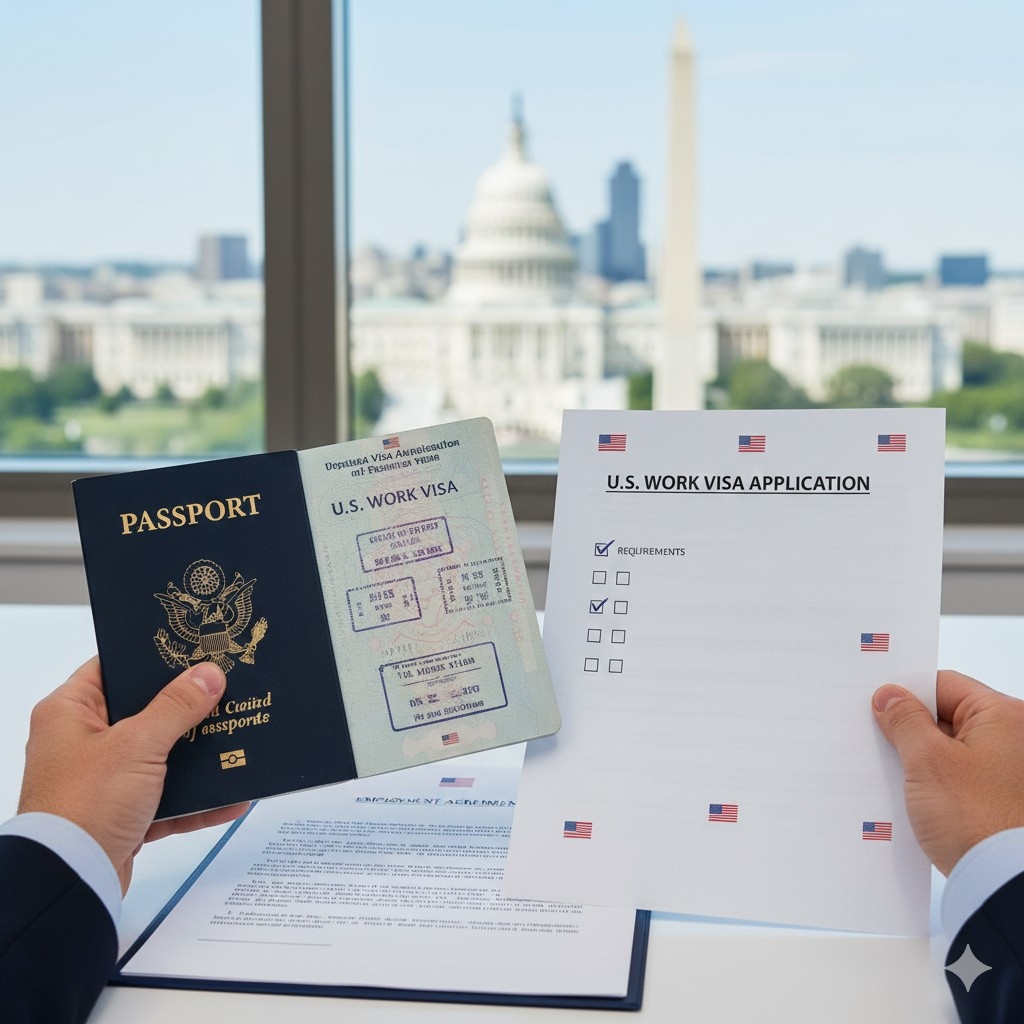
USA Work Visa Types Explained: Requirements, Processing & Costs (2025-2026)
The allure of working in the United States—with its innovation hubs, high salaries, and professional opportunities—is globally recognized. However, for a non-U.S. citizen, the journey from securing a job offer to legally working on American soil is entirely dependent on successfully navigating the labyrinthine structure of the U.S. immigration system.
Unlike the centralized, often fast-track processes found in other global economies, the U.S. requires a highly specific, category-driven approach. Your visa path is predetermined by your skill level, educational background, country of origin, and the specific employment relationship you have with your sponsoring company. Choosing the wrong category or failing to meet strict requirements can result in months of delay or outright rejection.
This definitive, in-depth guide is tailored for high-skill professionals planning a move to the U.S. in 2025–2026. We will meticulously break down the most vital non-immigrant work visas, detailing the specific requirements, realistic processing timelines, and the associated costs, empowering you to execute a strategic, successful relocation.
1. The Core Pillar: The H-1B Specialty Occupation Visa
The H-1B is the single most common visa for skilled international workers in the U.S. It is designed for temporary employment in a "specialty occupation."
1.1. H-1B Eligibility and Requirements
A specialty occupation is defined as one that requires the theoretical and practical application of a body of highly specialized knowledge, and a minimum of a Bachelor's degree (or foreign equivalent) for entry.
|
Requirement |
Detail |
Importance |
|---|---|---|
|
Specialty Occupation |
The job duties must be so complex that they require at least a Bachelor's degree in a specific field (e.g., Software Engineering, Finance, Architecture). |
Highest—must match the applicant's degree. |
|
Required Education |
Bachelor's degree (or higher) directly related to the job, or experience equivalent to a degree. |
Mandatory legal proof. |
|
Prevailing Wage |
The employer must pay the employee at least the higher of the actual wage paid to other employees or the DOL-determined prevailing wage for that occupation/location. |
Ensures fair wages and confirms scarcity. |
|
Employer Sponsorship |
The employer must file a Labor Condition Application (LCA) and the I-129 petition on the applicant’s behalf. |
Non-negotiable; the employee cannot apply for the H-1B alone. |
1.2. The H-1B Lottery and Quota System
The H-1B visa is subject to an annual cap, making the process a high-stakes lottery.
-
Annual Cap: 85,000 visas total.
-
Regular Cap: 65,000 visas for all applicants.
-
Master's Cap: 20,000 additional visas reserved for applicants who hold a U.S. Master's degree or higher.
-
-
The Lottery Process: Due to overwhelming demand (often exceeding 400,000 registrations), USCIS uses a random selection process, prioritizing the Master's Cap first. Registration typically occurs in March, with selected candidates starting work in October (the start of the U.S. fiscal year).
1.3. H-1B Processing Timelines and Costs
|
Stage |
Estimated Timeline |
Cost (Paid by Employer) |
|---|---|---|
|
Employer Registration |
March (Annual) |
$10 per registration |
|
Petition Preparation (Legal/Documentation) |
2–4 weeks |
$1,500 – $4,000 (Legal fees) |
|
USCIS Processing (Standard) |
2–6 months |
$1,710 – $3,210 (Filing Fees) |
|
Premium Processing |
15 calendar days |
+$2,805 (Expedited fee) |
|
Consular Interview (After Approval) |
1–4 weeks (Varies by Consulate) |
$205 (Visa Fee, paid by Applicant) |
Duration: Initial H-1B status is granted for up to three years, renewable once for a maximum total stay of six years. This makes the transition to a Green Card (Permanent Residency) essential.
2. The Multinational Bridge: The L-1 Intra-Company Transfer Visa
The L-1 visa is crucial for multinational corporations and avoids the H-1B lottery entirely. It is used to transfer executives, managers, or employees with specialized knowledge from a foreign office to an affiliated U.S. office.
2.1. L-1 Eligibility and Categories
|
Category |
Target Employee |
Key Requirement |
Duration Limit |
|---|---|---|---|
|
L-1A ADVERTISEMENT
|
Executive or Manager |
Must have been employed abroad in an executive or managerial capacity for at least one continuous year within the previous three years. |
7 years maximum |
|
L-1B |
Specialized Knowledge Employee |
Must possess advanced, proprietary knowledge essential to the U.S. company's operations that is not generally available in the U.S. labor market. |
5 years maximum |
2.2. L-1 Processing and Advantages
-
No Cap: The L-1 is not subject to annual quotas or a lottery. Petitions can be filed at any time of the year.
-
Blanket Petitions: Large, pre-approved companies can use the "Blanket Petition" process, which allows L-1 applications to be processed directly at a U.S. Consulate abroad, often speeding up the process significantly.
-
Spousal Employment: A major advantage of the L-1 visa is that the spouse (L-2) is eligible to apply for an Employment Authorization Document (EAD) upon arrival in the U.S., allowing them to work legally.
Cost: L-1 filing fees are comparable to H-1B fees (around $1,710 - $4,000+ total in filing fees and fraud prevention costs).
3. The Elite Path: The O-1A Visa for Extraordinary Ability
The O-1A visa is reserved for individuals who have demonstrated "extraordinary ability" in the sciences, education, business, or athletics. This path is rigorous but cap-exempt.
3.1. O-1A Requirements (The Evidence Test)
To qualify, the applicant must provide extensive documentary evidence of sustained national or international acclaim. This usually means meeting at least three of eight specific regulatory criteria:
-
Receipt of major, internationally recognized awards (e.g., Nobel Prize).
-
Receipt of lesser nationally or internationally recognized prizes or awards for excellence.
-
Membership in associations that require outstanding achievements (as judged by recognized national or international experts).
-
Published material about the applicant in professional or major trade publications or other major media.
-
Evidence of critical employment in organizations with a distinguished reputation.
-
Evidence of high salary or other remuneration for services.
-
Original scientific, scholarly, or business-related contributions of major significance.
-
Authorship of scholarly articles in professional journals or other major media.
3.2. O-1A Processing and Advantages
-
No Lottery/Cap: O-1 petitions can be filed at any time.
-
Duration: Granted for up to three years initially, renewable indefinitely in one-year increments as long as the work continues to be in the area of extraordinary ability.
-
Timeline: USCIS processing typically takes 2–5 months, but Premium Processing is highly recommended to receive a decision within 15 calendar days.
Cost: Similar filing structure to the H-1B, but legal fees are often much higher (up to $8,000 – $15,000+) due to the extensive documentation and petition writing required.
4. The Investor and Treaty Visas: E-1 and E-2
These non-immigrant visas are designed for individuals from countries that have specific treaties of commerce and navigation with the U.S. They do not lead directly to a Green Card but allow long-term stays.
4.1. E-1 (Treaty Trader)
-
Purpose: For individuals who conduct substantial trade principally between the U.S. and their treaty country. Trade must involve high volume and continuous transactions.
-
Requirements: Majority of trade must originate from or be destined for the treaty country.
4.2. E-2 (Treaty Investor)
-
Purpose: For individuals who invest a substantial amount of capital in a legitimate U.S. enterprise.
-
Requirements: The investment must be "substantial" (no fixed minimum, but generally high enough to show commitment), and the enterprise must be real and active (not passive) and show a significant contribution to the U.S. economy.
Duration and Spousal Work: Both E-1 and E-2 visas are granted for renewable periods (often two or five years). Crucially, the spouse of an E-1 or E-2 visa holder is eligible to apply for an EAD upon arrival in the U.S.
5. The Path for Students: F-1 Optional Practical Training (OPT)
For many international students graduating from U.S. universities, the F-1 visa with Optional Practical Training (OPT) is the vital bridge to H-1B sponsorship.
-
Standard OPT: Allows F-1 graduates one year of temporary employment directly related to their major field of study.
-
STEM OPT Extension: Graduates in Science, Technology, Engineering, or Mathematics (STEM) fields are eligible for a 24-month extension after the initial 12 months, providing a total of three years to work and attempt the H-1B lottery multiple times.
Strategy: International students often use their OPT period to secure a job at an H-1B high-volume filing company, increasing their chances significantly before the cap limits apply.
6. The Green Card Strategy: Navigating the Long-Term Goal
For almost all professional work visas, the ultimate goal is the Green Card (Permanent Residency), which removes employment restrictions and provides stability.
The Employment-Based (EB) Categories
Most workers transition through the EB-2 or EB-3 categories, which are dependent on employer sponsorship and the rigorous PERM Labor Certification process.
-
PERM Labor Certification: The mandatory first step where the employer proves to the Department of Labor that no qualified, willing, or available U.S. worker could be found for the role. This acts as the formal "shortage test."
-
I-140 Petition: Filed by the employer with USCIS after PERM is certified, petitioning for the foreign worker's classification as an immigrant worker.
-
Adjustment of Status / Consular Processing: The final step, which is subject to the Visa Bulletin and national quotas (retrogression).
The Crucial Role of Retrogression
Due to country-based quotas, applicants from high-volume countries like India and China face substantial delays (retrogression) in the final stage of Green Card processing. This necessitates using the full six years of the H-1B, often requiring extensions based on the pending Green Card case. This is why securing an employer committed to an early PERM filing is non-negotiable.
7. Strategic Advice: Maximizing Your Chances of Visa Success
The U.S. visa process is a competition for limited slots. Use these strategies to maximize your competitive edge:
-
Target the Right Employers: Focus exclusively on large, multinational companies or universities known for high-volume H-1B filing and L-1 transfers. They possess the legal sophistication to navigate the process.
-
Prioritize Skill Scarcity: Position your qualifications to meet the "Specialty Occupation" and high "Prevailing Wage" requirements (Level IV) needed for H-1B success. Highlight rare technical stacks or dual-domain expertise (e.g., Finance and AI).
-
Demand Green Card Clarity: Before accepting an offer, get a clear, written commitment from the employer regarding the timeline for initiating the PERM Labor Certification process. Waiting too long risks hitting the six-year H-1B limit.
-
Utilize Premium Processing: When available, Premium Processing cuts the USCIS review time to 15 calendar days. Although expensive, this can save months of anxiety and is a crucial service for high-value talent.
The Strategic Move
Securing a job and a work visa in the U.S. is fundamentally a legal and strategic exercise. Success in the 2025–2026 cycle depends on correctly identifying the visa category that best fits your profile (H-1B, L-1, O-1), partnering with a sponsoring organization committed to the long-term Green Card path, and meticulously preparing every piece of documentation to meet the government’s high standards.
Master the requirements, plan your timeline, and focus your career search on the critical shortage sectors—the U.S. economy needs your talent, but you must prove your right to work under its stringent rules.
About Admin
Related Articles

Highest Paying Jobs in the USA Without a Degree (2025–2026)
Explore the best high-salary jobs in the U.S. that don’t require a college degree. From skilled trades and transport to tech support and supervisory roles, learn earning potential, requirements, and how immigrants can apply in 2025–2026.
Admin
Nov 30, 2025

Best States for Jobs in the USA: Salaries, Living Costs & Job Demand (2025–2026)
Find out which U.S. states offer the best combination of high salaries, affordable living costs, and strong job demand. This guide highlights the top states for foreign workers and locals seeking better opportunities in 2025–2026.
Admin
Nov 30, 2025

Large U.S. Companies That Hire Foreign Workers Every Year (2025–2026)
Discover major U.S. companies that consistently hire foreign workers each year. See which industries sponsor visas the most — including tech, finance, healthcare, logistics, and engineering — plus the types of roles they recruit for.
Admin
Nov 30, 2025